

Publishers have traditionally grown revenue by increasing traffic: more visitors mean more advertising impressions and more opportunities to convert readers into subscribers. But this model depends heavily on audiences discovering content through search engines, social media and other external platforms.
As artificial intelligence changes how people find and consume information, there are growing signs that the need to visit publisher websites is declining, particularly with the rise of zero-click search.
The impact on publisher traffic is becoming increasingly visible. According to Similarweb data reported by Press Gazette, 41 of the top 50 US news websites saw traffic fall year-on-year in August 2026. Newsweek was down 72%, the Daily Mail 45% and Business Insider 42%. All three publishers have spoken publicly about falling search traffic following the expansion of Google's AI Overviews into news.
With Google's integration of Gemini into search, for example, users can increasingly get news, summaries and answers to specific questions without clicking through to the original publisher. Social media platforms have also changed how news and information are consumed, while audiences are becoming more accustomed to simply asking a question and getting an answer rather than searching, clicking and browsing.
As a result, the once-reliable flow of referral traffic is coming under increasing pressure, with publishers having relatively little control over how these changes affect their websites.
One response has been to invest more heavily in paid search to bring audiences back. In July 2026, Similarweb reported that publishers within its top 100 media index spent roughly $113 million on paid search, an increase of 41% year-on-year.
But the return is far from guaranteed. Publishers need to balance the cost of acquiring traffic against the advertising, registration and subscription revenue that traffic ultimately generates.
This raises an important question: rather than focusing primarily on acquiring more traffic, how can publishers generate greater value from the audience already visiting their sites?
The answer lies in better understanding those audiences, increasing engagement and building relationships that create value over time.
Turning visitors into engaged, loyal audiences
It's easy to think about audiences in terms of traffic, page views and impressions. But behind every visit is a person who needs to see value before they are willing to make a commitment.
For publishers, that value comes through content, relevant experiences and trust in the brand. These relationships are rarely built through a single visit. They develop progressively as readers engage more frequently and begin to recognise the value of what a publisher offers.
That means moving away from treating every visitor in the same way and towards understanding different audience types, their behaviour and their readiness to engage.
The goal is to progressively turn anonymous visitors into known users, build a clearer understanding of their interests and engagement, and use those insights to determine when and how to encourage registration, membership or subscription.
How can publishers put this into practice?
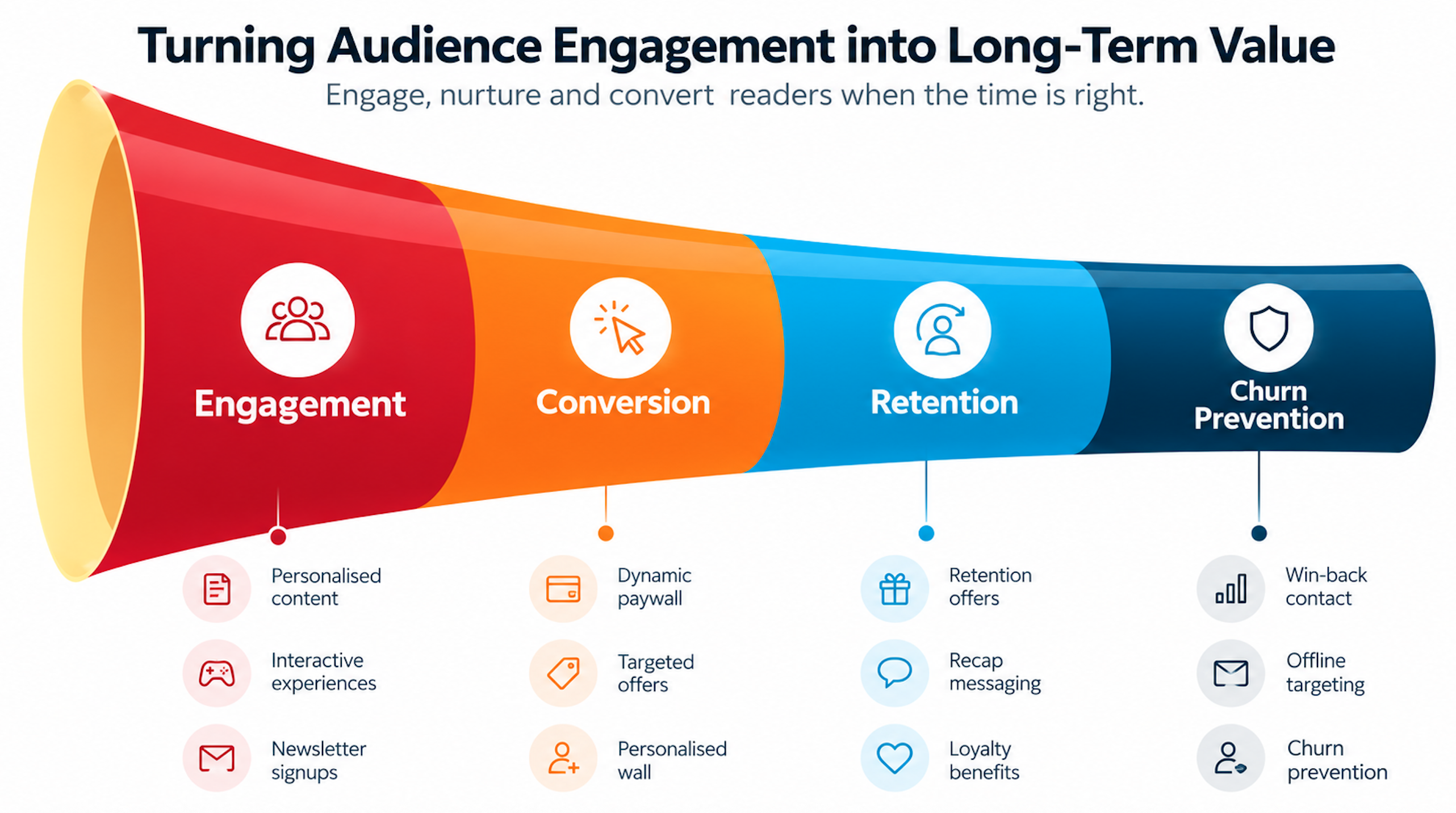
1. Start by engaging anonymous visitors
Not every visitor is ready to register or subscribe, particularly those arriving for the first time.
The initial focus should be on creating reasons to stay, explore and return. This could include personalised content recommendations, interactive experiences, competitions and other activities that encourage readers to engage beyond a single article.
At this stage, the priority is to demonstrate value rather than immediately ask for a commitment.
2. Understand behaviour and identify engagement signals
As visitors interact with content, publishers can begin to understand their interests and levels of engagement.
Signals such as visit frequency, time spent engaging with content, scroll depth, content preferences and interactions with site features can help build a clearer picture of audience behaviour.
Individually, these signals may reveal relatively little. But together, and tracked over time, they can help identify which readers are becoming more engaged and potentially more receptive to the next step.
3. Give engaged readers a reason to register
Once a visitor demonstrates interest, publishers can introduce opportunities to build a more direct relationship.
Rather than relying solely on generic registration prompts, the focus should be on offering something of value in return.
This might include saving articles, signing up for newsletters, accessing personalised features, participating in activities or unlocking additional content through registration.
These interactions help turn anonymous visitors into known users, while giving publishers a better understanding of their interests and preferences.
4. Use engagement and intent to guide monetisation
Registration is not the end of the journey. It creates further opportunities to understand users and develop the relationship.
By tracking engagement and intent over time, publishers can identify which users may be ready for a subscription, membership or other paid offering.
Dynamic paywalls, targeted offers, content access rules and membership benefits can then be used to present the right opportunity to the right audience at the right time.
Importantly, not everyone should receive the same offer or be asked to subscribe after the same number of articles.
5. Nurture readers who aren't ready to commit
Perhaps most importantly, publishers need to recognise that not every engaged reader is ready to pay.
Pushing registration or subscription too early can create unnecessary friction and risk losing audiences before their relationship with the publisher has developed.
A more selective approach allows users who demonstrate stronger intent to progress towards monetisation, while others continue to receive relevant experiences that encourage them to return and engage.
The objective is not to force every reader through the same journey, but to help each audience segment progress when the time is right.
Making more of the audience you already have
Declining referral traffic is changing the economics of digital publishing. While acquiring new audiences will always be important, publishers can no longer rely on traffic growth alone to drive revenue.
Increasingly, success will depend on how effectively publishers understand their audiences, create meaningful engagement and turn that engagement into long-term value.
This is where Evolok's engagement and monetisation platform can help.
By bringing together identity, audience segmentation, behavioural scoring and dynamic paywalls, Evolok enables publishers to create more relevant experiences and monetisation journeys based on how individual users behave and engage.
Rather than treating every visitor the same, publishers can identify opportunities to engage, register, nurture and monetise audiences at the right stage of their journey.
Because when traffic becomes harder and more expensive to acquire, making more of the audience you already have becomes more important than ever.


